
Trauma and PTSD Therapy in Maryland and Virginia
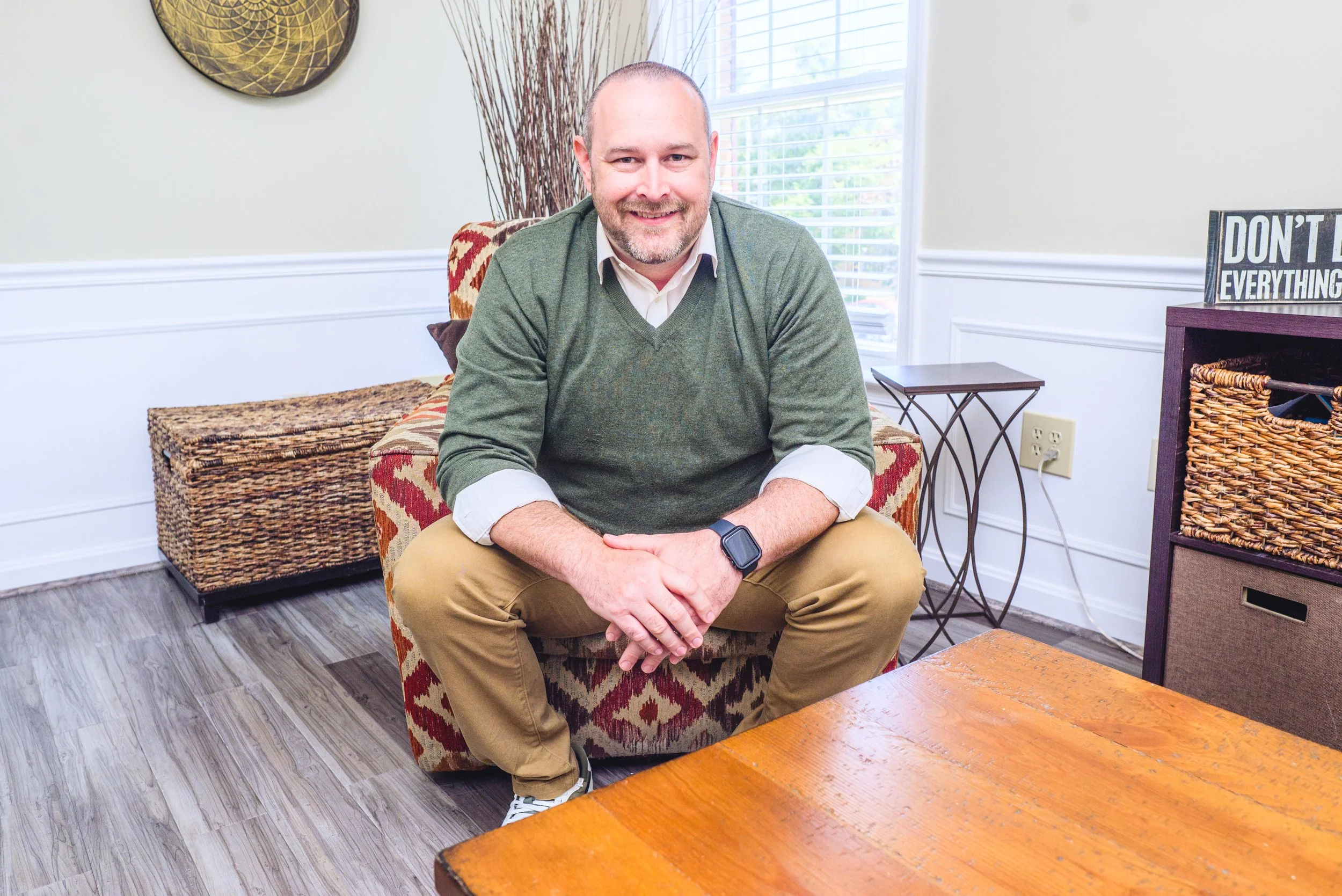
With Bradford Wolf, LCSW

Your reaction arrives before you do. Something small happens and your body has already decided it is serious, and by the time you catch up you have snapped at someone or gone quiet or left the room.
Maybe the sleep never came back. Maybe certain places, certain tones of voice, certain months of the year still register as dangerous for reasons that make no sense on paper.
Trauma therapy treats the lasting effects of experiences that overwhelmed your capacity to cope at the time. Some people come with a PTSD diagnosis. Most do not, and it is not required.
I am Bradford Wolf, a licensed clinical social worker in Rockville, Maryland. I work with trauma in adults in person and by video across Maryland and Virginia, as part of my individual therapy practice.
This page answers the two questions people actually arrive with: whether what happened to them counts, and whether starting means describing it. Then what the work involves, how long it takes, and what it costs.
If you are in crisis or having thoughts of suicide, call or text 988 to reach the Suicide and Crisis Lifeline. It is free and available any time.
Most people who should be in trauma therapy have already ruled themselves out. They run a comparison, decide other people had it worse, and conclude they have no business taking up the appointment.
The comparison is the wrong test. Trauma is not graded by the size of the event. What matters is whether the experience overwhelmed your ability to cope at the time, and whether your system is still organized around it now. Someone can be seriously affected by something that sounds unremarkable said out loud, and comparatively unaffected by something that sounds severe. That is not weakness on one side or strength on the other. It depends on age, on what support existed, on what else was happening, and on things nobody chooses.
It is also worth knowing this is ordinary rather than exotic. The National Institute of Mental Health notes that about half of U.S. adults will experience at least one traumatic event in their lives, and that most do not develop PTSD.
So the useful question is not whether what happened to you was bad enough. It is whether you are still carrying it.
"It was not that bad" is the wrong test
What it looks like years later

Very little of this announces itself as trauma. People book because of the anger, or the insomnia, or the third relationship that ended the same way, and the connection to what happened is often the last thing anyone makes.
A body still on alert. Scanning rooms, sitting where you can see the door, startling at things that do not warrant it, never quite unclenching.
Numbness and distance. Feeling less than the situation calls for, watching yourself from slightly outside, going flat when things get close.
Avoidance that has quietly shrunk your life. Routes you do not take, conversations you do not have, whole subjects that have become no-go areas. Usually this happened gradually enough that you never noticed deciding.
Reactions out of proportion. Anger that arrives at full volume, or tears that arrive from nowhere, and the exhausting work of managing both.
And sleep. Trouble getting there, trouble staying, dreams you do not discuss.
In men this more often surfaces as anger and shutdown than as fear or distress, which is one reason a lot of men read pages like this and conclude none of it applies to them. If what you recognize here is mainly the temper and the distance, therapy for men covers the same ground in more direct language. I am also trained in M-TREM, a trauma recovery model built specifically for working with men.
There is also the version with no single event: things that went on for years, or things that should have happened in childhood and did not. That work looks somewhat different and I will say so if it applies to you.
Trauma, PTSD, and which one applies to you
PTSD is a specific diagnosis. It has defined criteria, a required duration, and a particular cluster of symptoms. Trauma is the broader category: the lasting effect of overwhelming experience, whether or not it ever meets those criteria. Most people carrying trauma do not have PTSD.
If you do not have a diagnosis, you do not need one to start. Nobody checks paperwork at the door, and treatment is not gated behind a label.
If you do have one, or you are fairly sure you meet it, then yes, this is treatment for that. The work is somewhat more structured when PTSD is in the picture. There is usually more attention paid to stability before anything gets processed, a clearer role for EMDR, and closer tracking of what shifts and what does not. Say so in the consultation and I will tell you how I would approach it.
You do not have to tell me the whole story
This is the fear that keeps most people out, so let me answer it directly rather than reassuringly.
You will not be asked to sit down and narrate the worst thing that ever happened to you. Trauma treatment does not require a full account, and some of the approaches I use need very little detail at all. You decide what gets said and when. There is no session in which you are expected to produce the whole thing.
The first stretch of work is not about the event anyway. It is about steadiness: what helps you settle, what you do when something fires, what support exists around you. Nothing gets processed until there is enough capacity to process it without being flattened. If that takes several sessions, it takes several sessions.
I will also say something most therapists cannot. I have had EMDR done to me, as a client, not just administered it. I know what it is like to sit in that chair and not know whether it is going to work. That does not make me better at it than anyone else, but it does mean that when I say we go at your pace, I am not describing something theoretical.
If that sounds like a way you could start, book the free 15-minute consultation.

How I work with trauma
-
We map what fires, what it costs, and what already helps, and then build up your capacity to handle the difficult parts before going near them. People sometimes read this phase as delay. It is not. It is what makes the rest survivable, and skipping it is the main way trauma therapy goes badly.
-
When there is enough stability, the work turns to the memory itself and how your system stores it. EMDR is one of the tools I use for that, and it suits people whose talk therapy has stalled or who would rather not talk through the detail. That page covers what it actually involves. Other approaches work better for other people, and we decide together rather than by default.
-
For a lot of people the event connected to something older: how safe the world was assumed to be, what you learned to expect from people, which parts of yourself got put away to cope. I use parts work, which means treating those coping strategies as things that made sense at the time rather than as flaws, and attachment work for the patterns that formed early. This part is slower and it is usually where the change holds.
My training in this area includes EMDR and a series of depth trauma trainings, alongside the general clinical background. My background has the specifics if they matter to you.
How long this takes, and why I will not promise you five sessions
You will find practices in this area advertising trauma resolution in a set number of sessions, sometimes with a figure attached. I am not going to give you one.
What actually changes the answer:
Whether it was one event or years of something.
How long ago, and how much of your life has been built around avoiding it since.
Whether the present is stable enough to do the work from. Processing the past while the present is on fire does not go well.
Whether other things are running alongside it, which they usually are.
A therapist who tells you how many sessions your trauma will take before meeting you is telling you about their marketing, not about your treatment.
That said, refusing to promise is not the same as predicting a long haul. A single event, in someone whose life is otherwise steady, often moves faster than people expect, and I will tell you when I think that is the case. What I will not do is tell you before I know.
Military, federal, and first responder work
This area runs on federal agencies, military installations, the contractors around them, and the county's own fire, police, and EMS. The trauma that comes out of that work has a particular shape: usually cumulative rather than a single incident, often accumulated in a culture where saying it is getting to you carries a cost, and frequently sitting alongside genuine pride in the job.
There is also a question a lot of cleared personnel are carrying and not asking: does going to therapy put my clearance at risk?
The short answer is no, and the fear is more common than the risk. The Defense Counterintelligence and Security Agency states that there are no automatically disqualifying mental health conditions or treatments, and that seeking care can count in your favour as evidence of judgment. The SF-86 itself states that treatment in and of itself is not a reason to deny or revoke eligibility. What creates problems is an untreated condition affecting judgment, or being less than candid on the form.
I am a therapist and not a security attorney, so treat that as orientation rather than advice. Your facility security officer or a clearance attorney is the right person for your own situation.
What I do not do: VA disability claims, fitness-for-duty evaluations, or benefits navigation. Those need someone else, and I will point you toward them.
What it costs

A 50-minute session is $225. I am out of network, so you pay at the session, I give you a superbill, and you submit it for reimbursement. What comes back depends on your plan and your out-of-network deductible.
Trauma-trained therapists in this area often charge somewhat less than I do, and several take insurance, so this is a genuine choice rather than a corner you are being backed into.
The argument for working this way, on this particular problem, is about who controls the pace. Trauma work only functions when it moves at the speed the client can tolerate, and pace is the first thing to go when a third party is deciding how many sessions are authorised and how quickly progress should appear. Out of network, the timeline is set between the two people in the room and nobody else.
If the cost is out of reach, take the in-network option. There are trauma-trained clinicians on panels here and getting the work done matters more than getting it done with me. What reimbursement depends on covers the mechanics.
Book the free 15-minute consultation if you want to talk it through first.
In person in Rockville, online across Maryland and Virginia
I see clients at 27 Wood Ln in Rockville, MD 20850, and by video anywhere in Maryland or Virginia. The two-state limit is licensing rather than preference, which is also why I cannot see you if you are in the District.
For trauma work specifically, the setting matters more than it does for other things, and it goes both ways. Some people need their own space, where they control the room and can get up afterwards without a drive. Others need the separation, so the difficult material stays somewhere other than the house they sleep in. Either works, and it can change partway through. Online therapy in Maryland and online therapy in Virginia cover how the remote version runs.
If this sounds more like anxiety, depression, or something else
Trauma sits next to several things that get treated differently. Ending up in the right one matters.
If the alertness is the main event and there is no particular thing it traces back to, that may be anxiety.
If the dominant experience is flatness and weight rather than alarm, start with depression.
If it built up through work over years rather than arriving with an event, look at burnout.
If something has taken over as a way of not feeling it, compulsive behavior is worth reading. The two travel together often enough that treating one without the other tends not to hold.
Common questions about trauma therapy
-
No. Trauma treatment does not require a full narrative account, and some approaches need very little detail. You decide what is said and when. The early work focuses on stability rather than the event, and nothing gets processed before you are ready for it.
-
Yes, and most people do. PTSD is a specific diagnosis with defined criteria and a required duration. Trauma is the broader lasting effect of overwhelming experience. You do not need a diagnosis to be treated, and not having one does not mean it was not serious.
-
Some sessions are hard, and I am not going to pretend otherwise. But feeling worse is not the mechanism and it is not the goal. The pacing exists precisely so that difficult material is approached with enough capacity to handle it. If a session leaves you flattened for days, something needs adjusting, and you should say so.
-
It suits a lot of people, particularly those whose talk therapy has stalled or who would rather not narrate the detail. It is not the only option and it is not right for everyone. My EMDR page covers what the process involves, and we can work out in the consultation whether it fits.
-
It depends on whether it was one event or ongoing, how long ago, how much has been built around avoiding it, and how stable the present is. A single incident in an otherwise settled life often moves faster than people expect. I will not quote you a session count before meeting you.
-
Yes, with narrow legal exceptions I explain in the first session, mainly serious risk of harm and certain legal requirements. Disclosing something that happened to you does not trigger any of them. That question comes up often enough that it is worth answering plainly.
-
If you are in crisis or having thoughts of suicide, call or text 988 for the Suicide and Crisis Lifeline, any time, or go to your nearest emergency room. My practice is not an emergency service and I am not reachable between sessions for crises, which is worth knowing before you start.
Starting trauma therapy in Maryland or Virginia
Two things this page exists to say. What happened to you does not have to clear a bar to count. And starting does not require you to hand over the story.
The consultation is fifteen minutes on the phone. You can describe as much or as little as you want, including almost nothing, and still get a straight answer about whether I am the right person for this. I do not currently have a waitlist.
Book the free 15-minute consultation, or read more about individual therapy with me.
Sources
National Institute of Mental Health, "Post-Traumatic Stress Disorder (PTSD)," NIMH Statistics. https://www.nimh.nih.gov/health/statistics/post-traumatic-stress-disorder-ptsd
Defense Counterintelligence and Security Agency, "Mental Health and Security Clearances" fact sheet. https://www.dcsa.mil/Portals/91/Documents/pv/DODCAF/resources/DCSA-FactSheet_Mental-Health_SecurityClearances-Oct21.pdf