
Anxiety Therapy in Maryland and Virginia
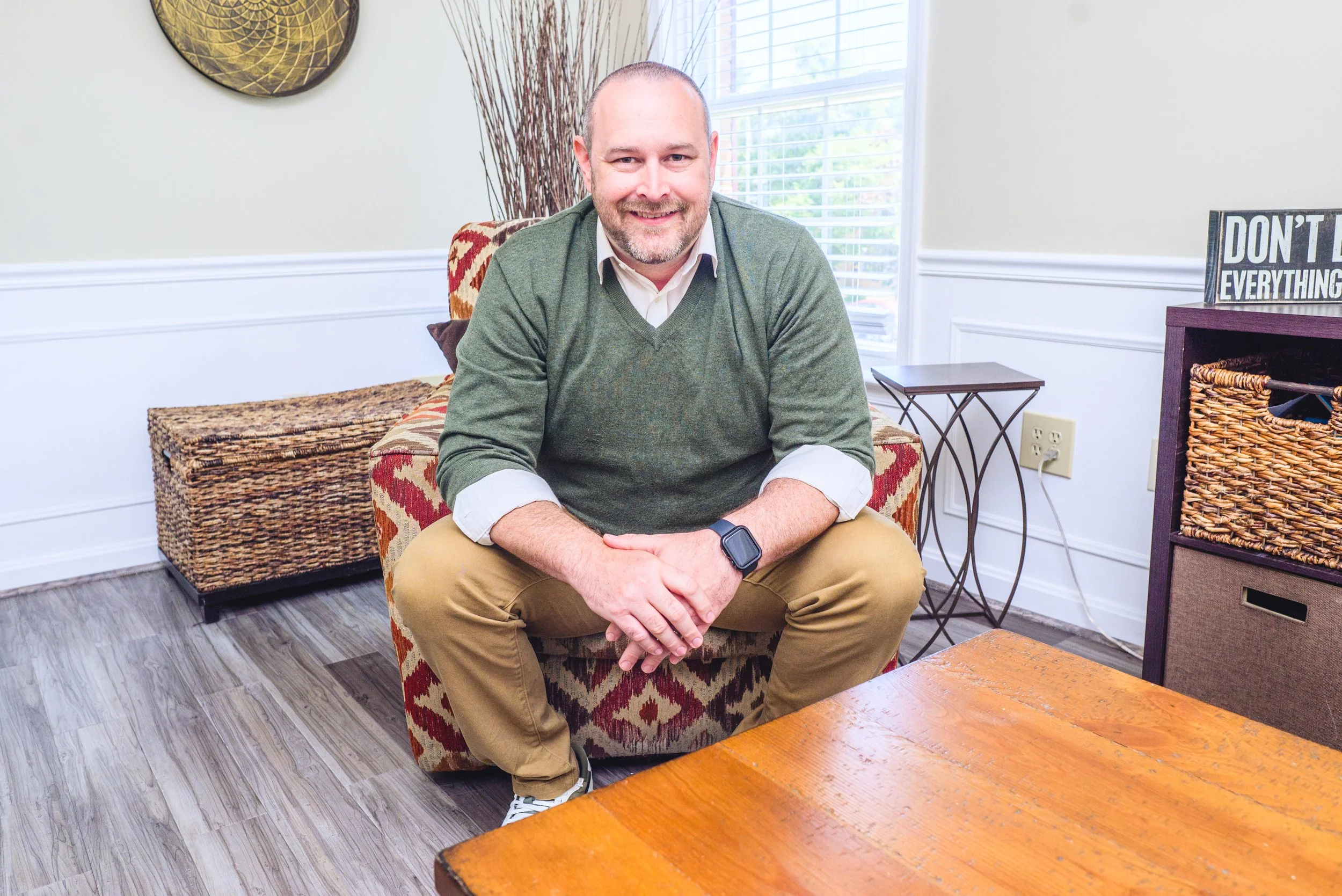
With Bradford Wolf, LCSW

You already know the feeling. The thought that starts at 11pm and is still running at 2am. The conversation you rehearsed eleven times before having it, then rehearsed again afterward. The email you have not opened, because opening it makes it real.
Anxiety therapy is the treatment of persistent worry, fear, and physical alarm through structured psychotherapy. It is not advice to relax, and it is not the breathing exercise you already tried.
I am Bradford Wolf, a licensed clinical social worker. I treat anxiety in adults in person in Rockville, Maryland, and by video across Maryland and Virginia, as part of my individual therapy practice.
This page covers what separates anxiety from ordinary worry, what the treatment involves week to week, how long it takes, whether to do it in person or online, and what it costs.
If you are in crisis or having thoughts of harming yourself, call or text 988 to reach the Suicide and Crisis Lifeline, any time.
When worry becomes something therapy treats
Ordinary worry tracks something real and stops when the thing resolves. Anxiety keeps running after the situation is over, or when there was never a situation to begin with.
Three signs the line has been crossed:
It does not switch off. The presentation went fine, and you are still reviewing it at midnight.
It spreads. It started with work. Now it is money, and health, and whether that text was short for a reason.
It has started making decisions for you. You take the call instead of the meeting. You drive instead of fly. You do not raise the thing that needs raising.
That third one matters most, and it is the one people are least likely to count. Avoidance feels like coping. It is actually the engine. Every time you route around the thing that frightens you, you get immediate relief and the fear gets slightly stronger, because you never found out it was survivable. That loop is what anxiety treatment interrupts.
None of this makes you unusual. The National Institute of Mental Health reports that about a third of U.S. adolescents and adults experience an anxiety disorder at some point in their lives. What separates the people who get better is not how severe it was. It is whether anyone showed them how the loop works.
What anxiety looks like once it has been running a while

After a few years, anxiety stops looking like fear and starts looking like your life. It shows up in four places, and each one responds to a different part of the work.
In your thinking. Rumination that loops without resolving. Catastrophising. Rehearsing conversations that have not happened yet and replaying the ones that have. Treatment changes what you do with the thought rather than trying to make you have fewer of them.
In your body. A jaw you did not know was clenched. Waking at 2am with your heart already going. Stomach trouble with no medical cause. This part responds to work that goes through the body rather than through the argument.
In what you do. Cancelling. Over-preparing. Taking the smaller version of the opportunity. Not opening the letter. This is avoidance, and it is where treatment does the most.
In what it costs you. Sleep, concentration, patience with the people you like most. Most people book when this fourth one becomes undeniable.
Some people have a sharper version. Panic attacks arrive as a sudden physical surge that peaks within minutes and leaves you shaken. Social anxiety concentrates the fear on being watched and judged. Both are treatable, and both respond to a more targeted version of the work below.

How I treat anxiety
Anxiety treatment is not open-ended talking. It has a shape, and the shape is the reason it works.
-
We map it before we change it. When it fires, what it goes after, what it has already cost you, and what you have tried. I will push for specifics. Not "I get anxious at work" but which meeting, which person, which hour of which day. Vague anxiety is hard to treat. Specific anxiety is very treatable, and most of the first few sessions are about making it specific.
-
This is the cognitive behavioral part, and it is more concrete than the name makes it sound. You catch a thought at the moment it fires. You write down what it predicted. Then you check what actually happened. Do that often enough and something shifts, though not the thing people expect: the thoughts do not stop, they stop being read as information. Most of this happens between sessions. I will ask you to do things during the week, and the people who improve fastest are the ones who do them.
-
This is exposure, and it is the part people are most afraid of, so let me be exact about what it is not. Nobody gets thrown into anything. You will not be told to do the worst thing on your list to prove a point.
What actually happens is that we build a list together, ordered from mildly uncomfortable to genuinely difficult. You start near the bottom. You stay in the situation long enough for the anxiety to come down on its own, which it does. Then you repeat it until it is boring, and move up one.
You set the pace and you agree to each step before it happens. That is not a courtesy, it is how the method works. Exposure done to someone rather than with them does not hold.
-
Anxiety runs through the nervous system, so part of the work is physical: what to do when your body is already going, and what makes it less likely to start. Short and practical, and not another meditation app.
Fifteen years of this has taught me that the method matters less than the fit between the method and whatever is actually driving the anxiety. Cognitive behavioral work is where I start with most people, and not with everyone. My background covers the rest of how I work.
How long anxiety therapy takes, honestly
You will find practices that promise results in a set number of sessions. I am not going to give you a number, and I would rather explain why than just decline.
Four things change the answer:
How long it has been running. Two years of worry moves faster than twenty.
How much you have built around it. Anxiety with a lot of avoidance attached takes longer, because there is more to unwind.
Whether something is actively feeding it. A job that is genuinely unsustainable is not a thinking error, and no amount of cognitive work will fix it.
Whether you do the work between sessions. This is the largest factor and the one I have the least control over.
A specific fear with a clear shape can shift in a couple of months. A lifelong low hum of worry takes longer than that. Anyone quoting you a session count before they have met you is guessing, and the number should be read accordingly.
In person or online, and why that choice matters more with anxiety
I offer both and I gain nothing either way, which is why I will tell you the choice is not only about convenience.
The case for video is genuinely strong. If what stands between you and weekly therapy is a commute, a workday with no gaps, or childcare, video removes the obstacle. Consistency matters more than setting.
There is a case for in person that almost nobody in this area makes, because most anxiety practices here are virtual only. When anxiety runs on avoidance, leaving the house and sitting in a room with another person is sometimes part of the treatment rather than a barrier to it. If your world has been quietly shrinking, getting here is the first exposure, and it is not a small one.
A rough rule: if the barrier is logistics, take the video sessions. If the barrier is that going places has become harder than it used to be, the room may be worth the drive.
I see clients at 27 Wood Ln in Rockville, MD 20850, and by video anywhere in Maryland or Virginia. The two-state limit is a licensing rule rather than a preference, which is also why I cannot see you if you are sitting in the District. If you are elsewhere in the state, online therapy in Maryland and online therapy in Virginia cover how that works.
What about medication?
I do not prescribe. I am a licensed clinical social worker rather than a psychiatrist, so this sits outside what I can do.
Plenty of people treat anxiety with therapy alone and do well. A prescriber is worth talking to when the anxiety is severe enough that you cannot engage with the work, when sleep has collapsed, or when you have done a solid course of therapy and are still stuck.
If that is where you land, I will say so, help you find someone, and coordinate with them. What I will not do is tell you whether to take medication. That is a conversation with someone qualified to have it.
What it costs, and why people choose out-of-network care for anxiety

A 50-minute session is $225. I am out-of-network, so I do not bill insurance directly. You pay at the session, I hand you a superbill, and you submit that for reimbursement. What comes back depends on whether your plan has out-of-network benefits and how much of that deductible you have already met.
Let me be straight about the comparison you are probably running. There are practices in this area that take insurance and will cost you a copay. That is a real difference and for some people it is the deciding one.
Here is what the difference buys. You see me, every session, for as long as the work takes. Not whoever has availability that week, and not a new therapist when someone leaves. Anxiety treatment depends on graded work that builds on itself in sequence, and it holds up considerably less well when the person holding the sequence changes. How often we meet is decided by the work rather than by what a plan authorizes.
If the cost genuinely does not work, take the in-network option. Consistent therapy you can afford beats better-fitting therapy you have to stop three months in. But if you have already tried the cheaper route and it did not hold, that is worth paying attention to before you try it again.
What reimbursement actually depends on covers the mechanics. If this sounds like the right fit, book the free 15-minute consultation.
If this sounds more like burnout, panic, or something else
Anxiety gets confused with a few things that need a different room. Being sent somewhere else is a good outcome here, because the wrong room wastes months.
If you are more empty than alarmed, and it tracks your job rather than following you home, that may be burnout rather than anxiety.
If the dominant feeling is flat rather than wired, where nothing is interesting rather than everything is threatening, start with depression.
If it began after something specific happened, and your body still reacts as though it is happening, that is trauma, and it is treated differently.
If you are a man who would not use the word anxiety but recognizes the short fuse, the bad sleep, and the pressure, therapy for men says the same things in language that may land better.
Common questions about anxiety therapy
-
Anxiety responds to structured treatment more reliably than most of what people bring to therapy. What changes first is usually not the feeling but the behavior: you start doing things you had been avoiding. The feeling follows, more slowly than anyone would like, but it follows.
-
Fifty minutes of mapping. I ask when the anxiety fires, what it targets, what it has cost you, and what you have tried. You do not need a diagnosis or a tidy account. Most people arrive with a mess, and sorting the mess is the work.
-
No. You do not need a diagnosis or a referral to begin. If you intend to seek insurance reimbursement, your insurer will generally require a diagnosis to appear on the superbill, and I will explain exactly what that means before it happens.
-
No. Every step is agreed in advance and you set the pace. We start well below the hardest thing on your list and move up only when the level you are on has stopped being difficult. You can stop or slow down at any point, and doing so does not undo your progress.
-
Yes, and I offer it across Maryland and Virginia. The exception worth thinking about is anxiety built heavily on avoidance, where physically getting to a session does some of the therapeutic work. We can talk that through in the consultation and change format later if needed.
-
No. I am out-of-network with all plans and do not bill insurers directly. You pay at the session and I provide a superbill you can submit for reimbursement. Call the number on your insurance card and ask what they reimburse for out-of-network outpatient mental health before you start.
Starting anxiety therapy in Maryland or Virginia
Anxiety is one of the more treatable things people bring to therapy, and it moves faster when the work is specific rather than general. The first step is a conversation, not a commitment.
Fifteen minutes, free, and a straight answer about whether I am the right person for this, including whether one of the other pages above fits you better. I do not currently have a waitlist.
Book the free 15-minute consultation, or read more about individual therapy with me.
Sources
National Institute of Mental Health, "Anxiety Disorders," NIMH Health Topics, page last reviewed December 2024. https://www.nimh.nih.gov/health/topics/anxiety-disorders