
Couples Therapy in Maryland and Virginia
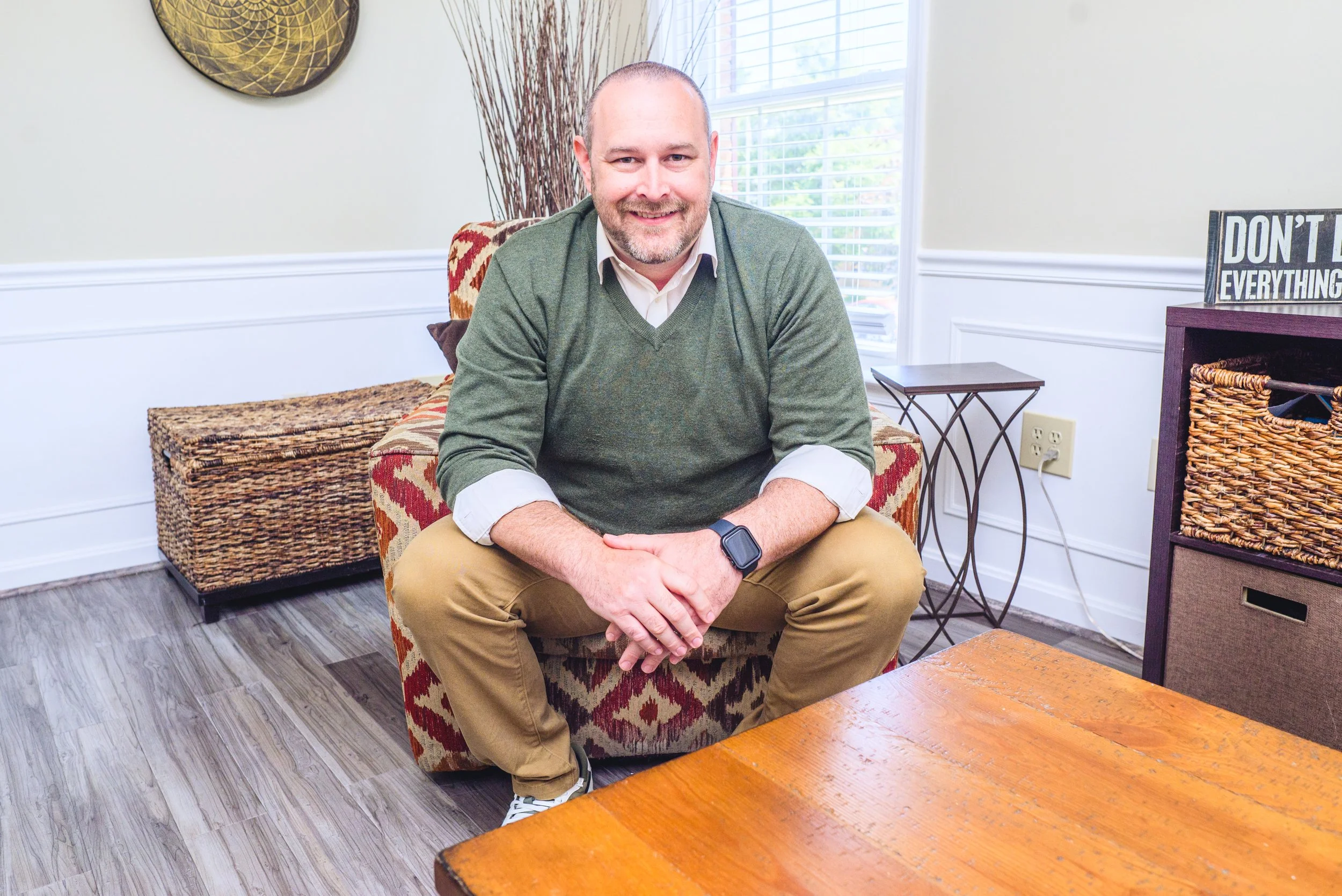
with Brad Wolf, LCSW
in person + virtual in Rockville, Md

You have had this argument before. You know roughly how it starts, you know what each of you is going to say, and you know how it ends. One of you shuts down, or one of you walks out of the room, and four days later it starts again over something that looks completely different.
Couples therapy is therapy with both of you in the room, working on the pattern between you rather than on either of you alone. I am Bradford Wolf, a licensed clinical social worker trained in the Gottman Method at Levels 1 and 2, with further training for couples dealing with addiction, affairs, and trauma. I see couples in Rockville and by video across Maryland and Virginia.
What is usually going on
The argument is rarely about the thing you are arguing about. The dishes are not about the dishes, and the text message is not about the text message. Underneath it there is usually a question one of you is asking and not getting answered. Do you still want this? Do I matter to you? Can I count on you?
A few shapes come up again and again:
One pursues, one withdraws: the more one of you presses for a conversation, the further the other one backs away, and both of you experience the other person as the problem.
The same fight on a loop: different subject every time, identical script. You could both perform the other’s lines.
Living like roommates: no fighting at all. Logistics, schedules, children, and almost nothing else. This one often gets ignored the longest because nothing looks wrong.
One of you feels invisible: present in the house, absent from the relationship.
If the second one sounds familiar, I have written about why that happens in why you keep having the same argument.

How I work with couples
I use the Gottman Method, which is a structured approach built on decades of observational research into what actually distinguishes relationships that work from ones that come apart. I am trained at Levels 1 and 2, with further training for couples dealing with addiction, affairs, and trauma. If you want the method explained properly, I have written a guide to the Gottman Method.
What it means in practice is that the work starts with assessment rather than advice. Before I say anything useful about your relationship, I need to see how the two of you actually talk to each other, and hear each of your histories separately. Only then does the work get specific.
I am not going to take a side. This is the fear almost every couple arrives with, and usually each of you privately suspects I will side with the other one. My client is the relationship. That does not mean I never say that something one of you is doing is not working. I will, to both of you, and probably in the same session.
Some background, briefly: I am listed on the Gottman Referral Network, the Gottman Institute’s own directory, and I have served as a head facilitator on marriage retreats. I am also married and a father of three, which is not a credential but does mean I am not describing any of this from the outside. More about my background.
What I will not promise is that your relationship survives. Some couples do this work and decide to separate, and when that decision is made clearly, with less damage and with both people understanding how they got there, that is a real outcome rather than a failure.
What the first few sessions look like

Couples work here follows a set sequence at the start, and it is worth knowing before you book, because the first month does not look like the weeks that follow.
First, a couples intake session: 75 minutes, both of you. This is the long one. I want the history of the relationship and what brought you here now. More usefully than either, I want to see how the two of you handle a disagreement in front of me.
Then an individual session with each of you: separately, one each. Your own history, your own account of the relationship, and what you personally want out of this. This is also the part that protects neutrality rather than threatening it: I hear each of you at the same length, in the same depth, without the other person in the room shaping what you say.
Then couples sessions: 50 minutes, usually weekly at first, working on the specific patterns the assessment turned up rather than on relationships in general.
Individual sessions do not have to stop there. Some people keep a regular individual hour going alongside the couples work, because something of their own surfaced in the assessment and is worth working on directly. That is a choice, not a requirement.
Book a free 15-minute consultation if you want to ask about any of this before committing to the first session.
If one of you is not sure about this
Most of the time, one person is reading a page like this and the other one does not know yet. Sometimes they know and are not keen.
That is normal, and it is not a reason to wait until you are both enthusiastic, because that day may not arrive. A reluctant partner usually is not refusing help. They are refusing a specific thing they are imagining, which is generally an hour of being told what is wrong with them by a stranger who has already made up their mind. It is worth finding out which version they are objecting to before you try to talk them into it.
The free consultation is a phone call, and either of you can be the one who makes it. Some partners come around once they have heard a voice rather than a plan.
When it is really one person’s problem
Sometimes what presents as a relationship problem is one partner’s untreated depression, anxiety, trauma, drinking, or anger, showing up where it is most visible. The relationship is where the symptom lands, not where the problem lives.
Because I work with individuals as well as couples, treatment for an individuals issues can be named, and treated here rather than somewhere else. The individual sessions are already part of how the work starts, so there is a natural place for it to surface, and a straightforward way to carry on with it.
If something underneath turns out to be the real work, these are the places to read about it: anxiety, depression, trauma, addiction and compulsive behavior, and anger. Individual therapy covers the rest.
What couples usually bring

-
the most common reason couples book, and the one with the most practical material already written. Start with four communication mistakes that damage relationships and communication exercises to try at home.
-
this is specific work with its own structure, and it is part of what my additional Gottman training covers. Rebuilding trust after infidelity is slower and more orderly than most people expect, and it does not begin with forgiveness.
-
when one of you is genuinely unsure the relationship should continue, that is a different conversation from working on it, and it is worth saying so at the start rather than six sessions in.
-
premarital work is mostly about finding the arguments you are going to have for the next thirty years while they are still theoretical.
-
for couples who want their faith in the room rather than politely worked around, Catholic counseling covers how I approach that.
What it costs

Fees follow the sequence above:
Couples intake session, 75 minutes: $275
Individual sessions, 50 minutes: $225 each
Couples sessions after that, 50 minutes: $250
I am out of network with all insurance plans, which means you pay directly rather than through an insurer. Fees, insurance, and FAQs covers how out-of-network reimbursement works, how payment is handled, and the cancellation policy.
One thing worth checking before you start: plans treat couples sessions differently from individual therapy, and the difference is larger than most people expect. If getting money back matters to your decision, call your insurer and ask specifically about couples sessions rather than about therapy in general.
In person in Rockville, online across Maryland and Virginia
The office is at 27 Wood Ln, Rockville, MD 20850. I am licensed in both Maryland and Virginia, so video sessions are available across both states.
What governs a video session is where you are physically sitting when it happens, not where you live. For couples that has one extra consequence: both of you need to be in Maryland or Virginia during the session. If one of you travels for work, that is worth planning around. Joining from two separate locations is fine, and fairly common for couples with opposite schedules.
Online therapy in Maryland and online therapy in Virginia go through the detail.
Common questions
-
No. My client is the relationship rather than either of you, and the structure of the assessment is built to make that real rather than just stated. Each of you gets an individual session of the same length before the regular work begins.
What I will do is say when something is not working, to whichever of you is doing it. That is different from taking a side, though it does not always feel different in the moment.
-
Yes, and it is a standard part of how couples work starts here. After the couples intake session, I meet with each of you individually, then we return to couples sessions. Individual sessions can also continue alongside the couples work if that turns out to be useful.
-
I am out of network with all plans, so I do not bill insurers directly. Plans vary considerably in how they handle couples sessions specifically, so ask yours about couples work rather than about therapy generally. Fees, insurance, and FAQs covers how out-of-network reimbursement works.
-
Then start with the consultation on your own and we can talk about what is actually being refused. It is also worth knowing that individual work on a relationship is legitimate in its own right. One person changing how they respond to a pattern changes the pattern.
-
The assessment sequence takes the first three or four sessions. After that it depends on what the assessment found and how long the pattern has been running. Couples who come in over one specific thing often work faster than couples who have been quietly drifting for a decade.
I will give you a straight answer about what I think it will take once I have seen the two of you, which is not something I can do from a website.
-
Yes, with a small number of legal exceptions I go through with you at the start. In broad terms they involve a serious risk of harm, certain situations involving a child or a vulnerable adult, and a court order. Nothing from your sessions goes to an insurer, because I do not bill insurance.
The individual sessions are confidential too. What you tell me in yours stays with me, and I will not repeat it to your partner. If something comes up that changes what the couples work can realistically do, I will raise it with you directly, and that conversation stays between the two of us as well.
-
Say so early. Working on a relationship and deciding whether to stay in one are different pieces of work, and running the second one disguised as the first wastes everybody’s time. If that is where one of you is, it is worth naming in the first session so the work can be aimed at the real question.
Start with a conversation
The consultation is fifteen minutes on the phone, free, and either of you can make the call. Both of you is fine too, if you would rather be on it together. You can ask what the work involves, what I would be looking for in the assessment, and anything you are worried about. There is no waiting list.
Book a free 15-minute consultation.
If either of you is in crisis and cannot wait for an appointment, call or text 988 to reach the Suicide and Crisis Lifeline, which is staffed around the clock.