
Addiction Counseling in Maryland and Virginia
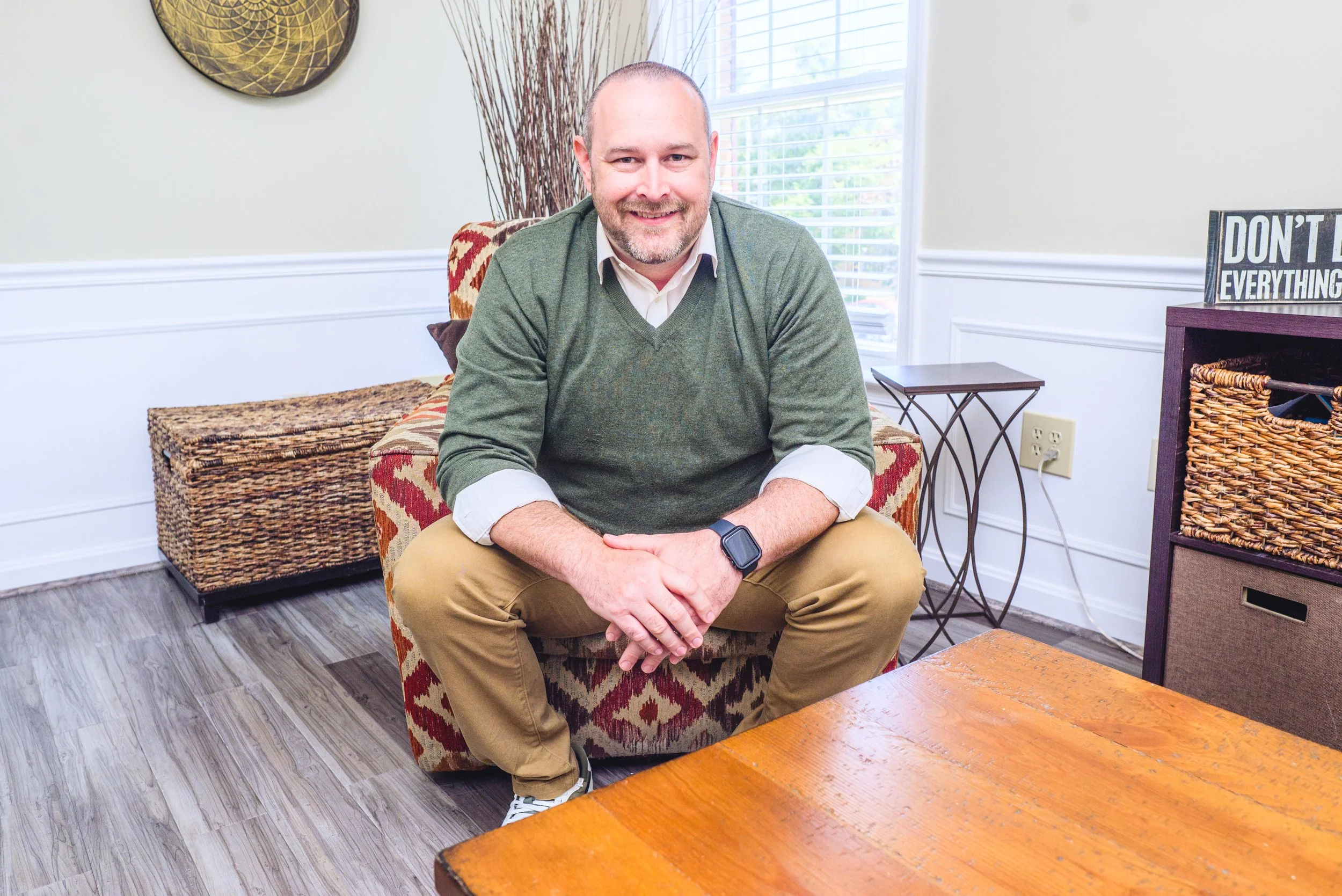
With Bradford Wolf, LCSW

You told yourself last night was the last one. You have told yourself that before, and you meant it every time, which is the part that is hardest to explain to anyone.
From the outside nothing looks wrong. You go to work, you answer emails, you show up for the people who need you. The gap between that version and what happens when you are alone has been widening for a while now.
Addiction counseling is one-on-one work on a behavior that has taken more room than you meant to give it and has not responded to willpower, whether or not a substance is involved. I am Bradford Wolf, a licensed clinical social worker in Rockville, Maryland, working with adults in person and by video across Maryland and Virginia, as part of my individual therapy practice.
What you say to me stays between us. I do not contact your partner, your employer, or anyone else. There are a few narrow legal exceptions, which I go through with you in the first session, and none of them are triggered by telling me what you have been doing.
This page covers whether this counts as addiction at all, what happens if you say it out loud, what the counseling actually involves, and what it costs.
Is it addiction if there is no substance?
This is where most people get stuck. There is no drug, no withdrawal, nothing a doctor could test for. So you conclude the problem is that you are weak.
The honest picture is more interesting than that, and worth knowing.
The American Psychiatric Association recognizes gambling disorder as the only behavioral addiction with a formal diagnosis in the DSM-5, and lists internet gaming disorder as a condition still requiring further study. Porn addiction, sex addiction, and phone or social media addiction are not diagnoses in that manual at all. Meanwhile the World Health Organization went further and recognized gaming disorder as a formal diagnosis in the ICD-11, under a category for disorders due to addictive behaviors. The two major classification systems do not fully agree with each other.
Two things follow, and most pages on this subject will only tell you one of them.
Not being in the manual does not mean it is not real, is not costing you, or cannot be treated. The DSM is a diagnostic instrument, not a list of problems worth getting help for. Plenty of what people bring to counseling has no diagnostic code attached to it.
And equally: be skeptical of anyone selling you certainty about mechanisms and cures for something the field itself has not finished defining. That includes me. What I can tell you is what tends to help, not what is guaranteed to.
The practical test is not diagnostic anyway. You have tried to stop, more than once, and it did not hold. That is enough to work with.
What it looks like from the inside

The decision gets made in advance and overridden anyway. You know at 4pm what you are going to do at 11pm, and knowing does not stop it.
The escalation is visible to you. What worked a year ago does not do the same thing now, and you have noticed the drift without being able to reverse it.
Time goes missing. Not metaphorically. Hours you cannot account for and did not intend to spend.
And there is the management. Where you do it, when, what gets cleared, what gets closed, what story covers the time. Most people underestimate how much energy that takes until it stops.
Then the cycle: relief, then the cost of it, then the resolve, then the reset. If you have been running that loop for years you have probably never seen it written down.
Here is the part worth understanding about why the willpower keeps failing. The behavior is doing a job. It is regulating something, usually a feeling you do not have another route to, and stopping it without replacing the function leaves the original problem there with nothing covering it. That is not an excuse and it does not make you less responsible. It explains why sixteen sincere attempts collapsed, which is the evidence you have been using against yourself.
Most of the behavioral side of this is men, and most of those men have told nobody at all. If that is you, therapy for men covers similar ground in more direct language.
What this usually looks like in practice
It tends to be one of these, and often more than one at a time. Treating them as one pattern rather than several separate problems usually works better.
Porn. It started as an ordinary thing and became the thing you organize the evening around, and what you are looking at now is not what you would have chosen a few years ago.
Gambling and sports betting. It began as something you did during the game, and now the game is something you do around the bet. Betting is legal here and advertised constantly, and a lot of people who never considered themselves gamblers are in deeper than they meant to be.
Video games. The hours went somewhere and took the rest of your life with them, and the parts of your life that used to matter have gone quiet.
Phone and social media. You pick it up without deciding to, and put it down two hours later feeling worse than when you started.
Alcohol and drugs. It stopped being a choice you make in the evening and became the shape the evening has.
Sex and out-of-control sexual behavior. The risk has been climbing and the gap between what you do and who you understand yourself to be has become hard to sit with.
What I do, and what I do not
What this is: weekly one-on-one counseling, in my office or on video. There is nothing to enroll in, no group to join unless you want one, and nobody else involved unless you choose to involve them. You come in, we work, you go back to your life.
That matters more than it might sound. If you are functioning at work and hiding this, you probably do not see yourself in anything that sounds like checking in somewhere, and the absence of that structure is what makes this reachable.
What this is not: I do not provide medically supervised withdrawal, round-the-clock care, or a place to stay. I do not prescribe or manage medication. If what is going on calls for that level of support, I will tell you plainly rather than take you on and hope it works out, and I will help you find it.
One more thing worth saying. Twelve-step groups help a great many people, and nothing here is in competition with them. If you are already in one, this works alongside it fine.
If drinking is the main thing, read this first
If you have been drinking heavily every day for a long stretch, talk to a doctor before you stop suddenly. Stopping abruptly after sustained heavy use can be medically serious, and that is a medical question rather than a counseling one. It comes before anything I do.
I am telling you that because getting it wrong matters, not to send you away.
For a lot of people, drinking is more habit and coping than physical dependence, and that is exactly the ground counseling works on. If you are not sure which describes you, that is a reasonable thing to ask a doctor and a reasonable thing to raise with me.
SAMHSA runs a free, confidential line at 1-800-662-HELP (4357), staffed 24 hours a day in English and Spanish, which can point you toward local options if you need more support than one-on-one counseling.

How the counseling works
-
We start with when it fires and what is happening just before. Not to catalogue your failures, but because the triggers are specific and most people have never mapped them. Usually a pattern shows up within a few sessions that neither of us would have guessed from the outside.
-
Then the practical work: what happens in the twenty minutes before, what changes about access, what you do instead that actually does the job the behavior was doing. This is where relapse prevention and accountability come in, and both are more concrete than they sound. Relapse is expected rather than disqualifying, by the way. Nobody gets dropped for it. If you assumed otherwise, that assumption keeps a lot of people from starting.
-
Frequently there is something older down there. Trauma turns up often enough in this work that treating the behavior alone tends not to hold. Sometimes it is loneliness, or a stretch of life that went wrong years before the behavior started. We get there when there is room for it, not on day one.
I have worked with adults on compulsive behavior for a long time as part of a general clinical practice. I am not a certified addiction specialist and I will not claim to be one. My background sets out what I am trained in.
What it costs

A 50-minute session is $225. I am out of network, which means you pay at the session, I give you a superbill, and you submit it for reimbursement if you want to. What comes back depends on your plan and your out-of-network deductible.
On this particular subject, there is a reason to think about that arrangement beyond the money.
Billing insurance requires a diagnosis on the claim. For most things that is unremarkable. For this, it means a code describing what you came in for enters a claims record outside my office. Paying directly means no claim, no code, and nothing about this existing anywhere except between us.
That is not a warning about insurance and I am not suggesting your records are unsafe. For plenty of people it makes no difference at all. But if the thing you are most worried about is who could ever find out, it is worth knowing that the two arrangements are not the same in that respect.
If the cost is genuinely out of reach, use your insurance and find someone in network. Getting this addressed matters more than getting it addressed with me. What reimbursement depends on covers the mechanics.
If you want to talk it through first, you can arrange a free 15-minute call.
In person in Rockville, online across Maryland and Virginia
I see clients at 27 Wood Ln in Rockville, MD 20850, and by video anywhere in Maryland or Virginia. The two-state limit is licensing rather than preference, which is also why I cannot see you if you are in the District.
Video has an obvious advantage here: no waiting room, no building, nobody who might recognize your car. For some people that is what makes starting possible at all. Others find the opposite, that having to physically go somewhere is part of what makes it count. Both are workable and you can change your mind later. Online therapy in Maryland and online therapy in Virginia cover how the remote version runs.
If this is really about something else
Sometimes the behavior is the surface of something that needs addressing in its own right.
If something happened, and the behavior arrived afterward as a way of not being in your own head, start with trauma therapy. The two go together often enough that working on one alone usually does not hold.
If the behavior is mainly what you do to stop the noise, look at anxiety.
If the flatness came first, and the behavior arrived as one of the few things that still registered, look at depression.
If you are Catholic and the shame around this is specifically religious in shape, faith-integrated counseling means working with your faith in the room rather than treating it as another source of judgment.
And if you are here because of someone else's behavior rather than your own, that is a real thing needing real support, and it is not the same work. I am building a page on it. In the meantime, it is a reasonable thing to raise on a consultation call.
Common questions
-
Yes. What you tell me stays between us, and I do not contact anyone in your life. The exceptions are narrow and legally defined, mainly serious risk of harm to you or someone else, certain situations involving a child or vulnerable adult, and court orders. I go through them in the first session.
-
No. A lot of people assume they need to have it under control before they are allowed to ask for help, and that assumption costs them months or years. You can come in mid-pattern. That is the ordinary starting point, not the exception.
-
It is expected and it is worked with rather than penalized. Nobody gets dropped for it. What matters is what we learn from the specifics of it, which is usually more useful than a stretch of unbroken abstinence would have been.
-
No. Not unless you decide you want them involved, in which case we can plan how that goes. Some people eventually want a conversation with their partner in the room, and some never do. Both are legitimate and it is your call, not mine.
-
The classification is genuinely unsettled. Gambling disorder has a formal DSM-5 diagnosis, gaming disorder has one in the WHO system but not the American one, and porn, sex, and phone use have none. That says something about the state of the research, not about whether your life is being affected.
-
No. I am out of network with all plans and do not bill insurers directly. You pay at the session and I provide a superbill you can submit yourself. On this subject that also means no diagnosis goes onto a claim, which matters to some people and not to others.
-
Then I will say so. Weekly one-on-one counseling is not right for every situation, and if you need more than it can offer I would rather tell you early and help you find it. If you want to look yourself, SAMHSA runs a free confidential line at 1-800-662-HELP. If you are in crisis or having thoughts of suicide, call or text 988.
Starting addiction counseling in Maryland or Virginia
Two things worth taking from this page. It does not need a diagnosis to be worth addressing. And saying it out loud to one person does not set anything in motion.
The first step is fifteen minutes on the phone. Nothing is recorded, nobody is contacted, and there is no obligation at the end of it. You can describe as much or as little as you want and still get a straight answer about whether this is worth your time.
If today is not the day, that is fine. Most people read something like this several times over several months before they call. That is a normal way to arrive.
Arrange a free 15-minute call, or read more about individual therapy with me.
Sources
American Psychiatric Association, "Substance-Related and Addictive Disorders," DSM-5 fact sheet. https://www.psychiatry.org
World Health Organization, ICD-11 for Mortality and Morbidity Statistics, 6C51 Gaming disorder. https://icd.who.int
Substance Abuse and Mental Health Services Administration, National Helpline. https://www.samhsa.gov/find-help/helplines/national-helpline